


Top 5 Team-Building Destinations in Thailand That Turn Ordinary Teams into All-Star Crews
Teams do not become stronger through scenery alone. They develop through shared challenges, unfamiliar contexts, and experiences that interrupt habitual thinking patterns. Thailand offers a rare combination of environments that support focus, resilience, creativity, and collaboration without relying on gimmicks. When retreats are designed around outcomes rather than entertainment, these destinations create measurable shifts in how teams communicate, decide, and perform together.
What follows are five destinations that consistently support effective team development when paired with intentional programme design.
Khao Yai: Nature-Driven Strategy and Collective Reset
Khao Yai’s expansive landscapes and proximity to Bangkok make it a powerful setting for leadership and strategy-focused retreats. Wide open environments reduce mental noise, allowing teams to slow decision-making, examine assumptions, and engage in more honest dialogue. Research into nature exposure shows improvements in cognitive flexibility and problem-solving capacity, which explains why strategy sessions held outside urban settings often feel more productive.
Teams typically engage in leadership simulations built around navigation, prioritisation, and resource planning, followed by structured reflection. Forest walks paired with facilitated discussion help surface strategic insights, while conservation-linked workshops reinforce long-term thinking and shared responsibility. Vineyard-based challenges introduce timing, delegation, and trust dynamics without unnecessary pressure.
Khao Yai works particularly well for senior leadership teams, strategic planning offsites, and organisations seeking alignment after periods of growth or uncertainty.
Hua Hin: Structured Retreat with Coastal Ease
Hua Hin appeals to teams that value structure, predictability, and balanced pacing. The destination combines calm coastal settings with dependable meeting infrastructure, allowing programmes to run with clear agendas while still benefiting from a relaxed atmosphere. This balance suits teams that are newer to offsites or that prefer clearly defined objectives.
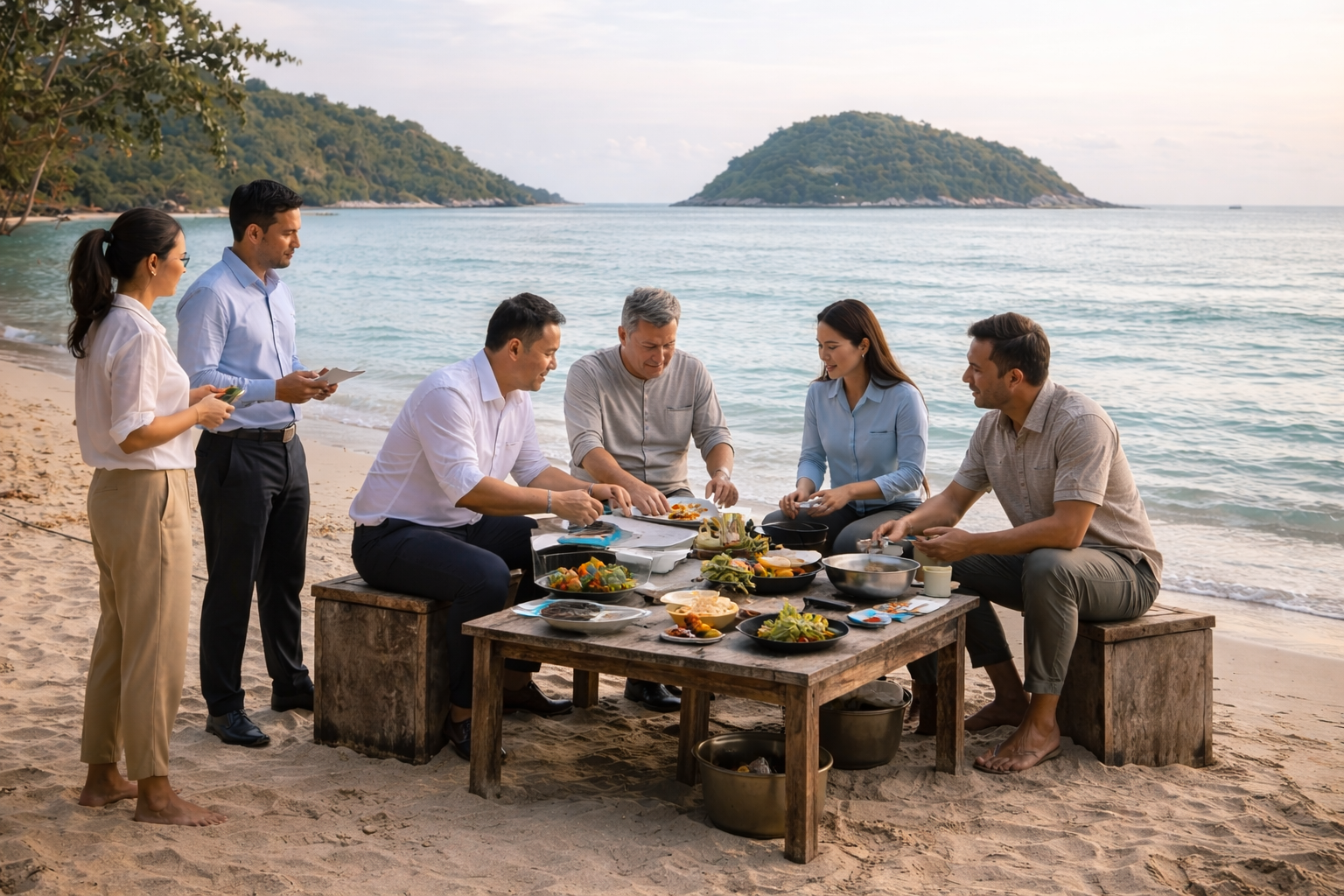
Programmes in Hua Hin often focus on communication and coordination. Beach-based collaboration exercises highlight how information flows under light pressure, while culinary challenges introduce time constraints and shared accountability. Leadership exercises inspired by golf principles, such as focus and situational awareness, translate well even for non-players.
Hua Hin is especially effective for cross-department teams, first-time corporate retreats, and organisations aiming to strengthen collaboration without overwhelming participants.
Kanchanaburi: Reflection, History, and Team Resilience
Kanchanaburi offers a reflective setting shaped by rivers, forests, and historical landmarks. The destination supports programmes centred on resilience, empathy, and perspective, making it suitable for teams navigating change. Exposure to historical narratives, when combined with guided discussion, encourages emotional intelligence and deeper interpersonal understanding.
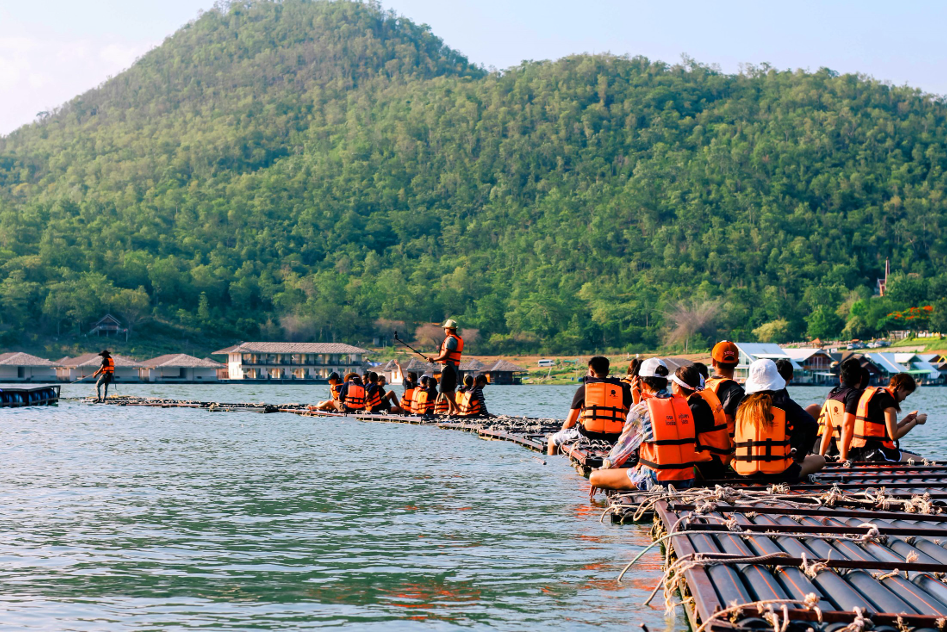
Teams often take part in river-based challenges that require role rotation and joint decision-making, followed by facilitated historical walks that anchor reflection in real context. Adaptability tasks test trust under pressure, while community engagement projects introduce shared purpose beyond organisational goals.
This destination suits leadership development programmes, transformation initiatives, and teams experiencing cultural or structural change.
Rayong: Coastal Focus Without Distraction
Rayong delivers coastal environments without the intensity of mass tourism, creating space for deeper engagement. Fewer distractions allow teams to slow conversations, listen more closely, and engage with intention. Research into retreat design shows that reduced external stimulation supports reflection and sustained group focus.
Activities in Rayong often mirror real workplace scenarios. Beach-based problem-solving sessions explore decision-making patterns, while island-hopping tasks require planning, timing, and shared responsibility. Cooking sessions with rotating leadership roles reveal natural influence dynamics, and sunrise wellness routines paired with goal-setting workshops support both recovery and alignment.
Rayong works well for mid-sized teams seeking privacy, balance, and a quieter environment where meaningful dialogue can unfold.
Pai: Creative Thinking in a Mountain Setting
Pai’s mountain valley atmosphere encourages openness and experimentation, making it effective for creative and innovation-driven teams. Exposure to novel environments has been linked to increased divergent thinking, and Pai’s slower pace invites participants to step outside habitual roles.
Retreats often include outdoor ideation sessions, storytelling workshops, and mindfulness practices connected directly to creativity exercises. Countryside cycling routes provide natural checkpoints for problem prompts, while small-group communication challenges emphasise listening and trust over performance.
Pai is best suited for innovation labs, creative departments, and organisations investing in culture-building or early-stage idea development.
Choosing the Right Destination for Your Team
Effective retreats begin with clarity around objectives. Leadership alignment, recovery, creative exploration, and team bonding each require different conditions. Team size influences facilitation style and logistics, while seasonality affects the feasibility of outdoor programmes. Selecting destinations based on outcomes rather than popularity consistently produces stronger results.
Thailand’s lesser-known destinations often deliver the greatest impact because they remove distraction and create space for teams to reconnect with purpose, direction, and each other.